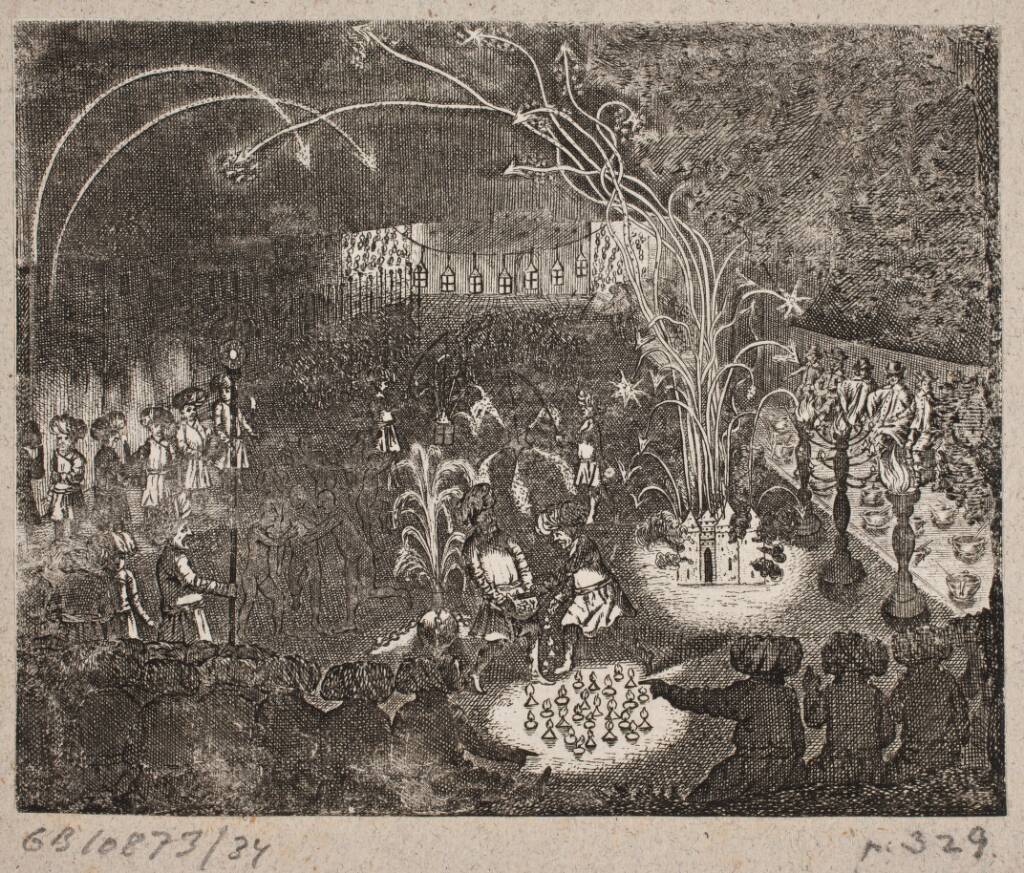
Persisk banket med fyrværkeri
✦ Read about this
This engraving, dated 1647, records a Persian banquet accompanied by a fireworks display. Its maker is unknown, a common circumstance for printed images of the period, when many engravings circulated without a named author.
Copper engraving allowed such scenes to be reproduced and distributed widely, feeding European curiosity about distant courts and their ceremonies. Depictions of Persia in particular drew on diplomatic contacts and travel accounts, though the accuracy of any given image varied considerably.
The print is held by the National Gallery of Denmark (SMK).
Background drawn from SMK — National Gallery of Denmark
Today's poem
I Wandered Lonely As A Cloud
I wandered lonely as a cloud That floats on high o'er vales and hills, When all at once I saw a crowd, A host, of golden daffodils; Beside the lake, beneath the trees, Fluttering and dancing in the breeze. Continuous as the stars that shine And twinkle on the milky way, They stretched in never-ending line Along the margin of a bay: Ten thousand saw I at a glance, Tossing their heads in sprightly dance. The waves beside them danced, but they Out-did the sparkling leaves in glee; A poet could not be but gay, In such a jocund company! I gazed—and gazed—but little thought What wealth the show to me had brought: For oft, when on my couch I lie In vacant or in pensive mood, They flash upon that inward eye Which is the bliss of solitude; And then my heart with pleasure fills, And dances with the daffodils.
William Wordsworth · Public domain
✦ Read about this
William Wordsworth was an English Romantic poet who, with Samuel Taylor Coleridge, launched the Romantic Age in English literature through their joint 1798 collection *Lyrical Ballads*. He stands among the central figures of English Romanticism.
"I Wandered Lonely as a Cloud" is built from four six-line stanzas, each rhyming ababcc in regular iambic tetrameter. The poem describes the speaker coming upon a vast expanse of daffodils by a lake, dancing in the breeze, and compares them to the stars of the Milky Way stretched in a "never-ending line."
Its central idea is the lasting value of the remembered scene. The speaker does not fully grasp what the sight has given him until later, when the daffodils return to his "inward eye" in moments of solitude, filling his heart with pleasure. The poem thus dramatizes a characteristic Romantic theme: the mind's capacity to store and recall natural experience.
Background drawn from PoetryDB & Wikipedia